
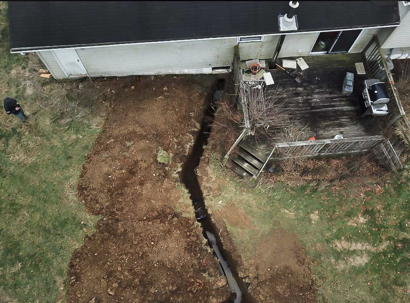
The most common geothermal misconception I hear is, “I do not have enough yard.” Sometimes the site really does limit the options. Often, the homeowner is picturing only a large horizontal field and does not realize that loops can be installed in several configurations.
A small lot is not an automatic no. It is a reason to evaluate the property.
Geothermal does not require one particular loop layout
A ground-source heat pump exchanges heat through buried pipe or groundwater. Common approaches include:
Horizontal closed loop
Pipe is installed in trenches across a larger area. This can be economical where open land and suitable soil are available, but it causes more surface disturbance.
Vertical closed loop
One or more boreholes place the heat exchanger deeper in the ground. Vertical drilling uses a much smaller surface footprint and can make geothermal possible on constrained lots. Bore depth, spacing and total length are engineering decisions, not fixed homeowner rules.
Pond loop
Where a suitable body of water exists and regulations allow it, closed-loop piping can exchange heat with the pond. The pond's depth, volume and seasonal behavior must be evaluated.
Open loop
An open-loop system uses groundwater directly and then discharges it through an approved method. Well yield, water quality, permitting and discharge conditions are critical.
DOE describes both vertical and horizontal buried loops and emphasizes site characteristics and qualified design.
What determines whether the site works
- The home's calculated heating and cooling loads.
- Soil or rock conditions and thermal properties.
- Access for drilling or excavation equipment.
- Wells, septic systems, utilities and property setbacks.
- Trees, structures, driveways and future plans.
- Groundwater availability and quality for an open-loop design.
- Local permits and environmental requirements.
The required loop depends on the load and ground conditions. A rule such as “so many feet per ton” may be useful for a rough conversation but is not a final design.
Why vertical loops change the space question
Vertical bores concentrate the loop field into a limited surface area. That does not mean they can be placed anywhere. Boreholes need appropriate separation, access and clearance from other site features. The advantage is that the usable ground is mostly below the yard after installation.
When I tell a homeowner that a surprisingly small area may support geothermal, I am not promising that every small lot works. I am saying the lot deserves a real layout before the idea is dismissed.
Consider the property after installation
A closed loop is buried and does not require outdoor condenser equipment. Landscaping can often be restored, but the final plan should protect headers, vaults and loop locations from later excavation. Keep accurate records for future fences, pools, additions and utility work.
Frequently asked questions
Can geothermal go under a driveway?
Some designs can use areas that will later be paved, but construction sequence, pipe protection, access and future repairs must be planned by the designer and installer.
Do vertical loops need a huge drilling rig?
Equipment size and access vary by driller, geology and bore design. A site visit is the only dependable way to determine access.
Can an existing home get geothermal?
Yes. DOE notes that ground-source systems can be added to existing buildings. The project must address loop access, indoor equipment, ducts or hydronics, electrical service and restoration.
Start with a site and load review
West Jefferson Plumbing & Heating designs and services geothermal systems across Central Ohio. We can evaluate a property in Circleville, Pickaway County, Ross County, Fairfield County or Fayette County before yard size is treated as the final answer.
Suggested internal links: HVAC Services; Circleville Service Area; Article 14 in this package Authoritative sources: DOE Geothermal Heat Pumps; DOE Heat Pump Systems