
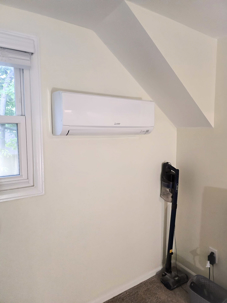
Ductless mini-splits can solve comfort problems that are difficult or expensive to address with conventional ductwork. They are especially useful for additions, finished garages, older homes without ducts, bonus rooms and spaces that need independent control.
They are not automatically the best answer for every room. The home still needs a load calculation, equipment selection and a plan for moving conditioned air.
What a mini-split is
A mini-split is an air-source heat pump with one outdoor unit connected to one or more indoor units. The indoor unit may be a familiar wall-mounted head, a ceiling cassette or a compact concealed ducted unit.
Because it transfers heat, it can provide efficient cooling and heating. DOE identifies mini-splits as a particularly useful retrofit for homes without existing ductwork.
Where ductless works well
- A sunroom or addition that the central system does not serve.
- A finished attic, garage apartment or workshop.
- A boiler-heated home that needs air conditioning without full-size ducts.
- A bedroom or home office with a different schedule from the rest of the house.
- A problem zone where extending ducts would be disruptive.
The ability to control a zone independently can improve comfort and avoid conditioning unused space.
One head does not guarantee whole-floor comfort
An open living area can distribute air reasonably well. Closed bedrooms and hallways are different. A wall unit in the living room cannot force the same amount of heating or cooling through a closed bedroom door.
Before installation, decide which rooms must maintain temperature with doors closed. That may point toward multiple indoor units, a compact ducted air handler or another distribution approach.
Cold-weather performance must be selected, not assumed
Modern cold-climate heat pumps can provide useful capacity at low temperatures, but every model has performance limits. The nominal size on the brochure does not tell the entire winter story.
A contractor should compare the home's design heating load with manufacturer capacity data at Central Ohio winter conditions. The plan should also address defrost, condensate, snow clearance and supplemental heat, if required.
Oversizing creates its own problems. An indoor head with too much minimum capacity can cycle in a small room and provide poorer temperature or humidity control.
Installation details homeowners notice later
Condensate drainage
Cooling removes moisture. The drain needs reliable slope, freeze protection where relevant and accessible maintenance. Pumps add flexibility but also sound and service needs.
Line-set routing
Refrigerant lines, control wiring and drains should be protected, supported and finished neatly. Exterior line-hide placement deserves discussion before holes are drilled.
Cleaning access
Filters, blower wheels and coils need maintenance. Install the indoor unit where it can be accessed safely.
Electrical capacity
The outdoor unit needs a properly sized dedicated circuit and disconnect. Multi-zone systems and backup heat must be included in the electrical plan.
Frequently asked questions
Will a mini-split heat during an Ohio winter?
Properly selected cold-climate models can heat at low outdoor temperatures. Capacity and efficiency change with temperature, so use model-specific data and a load calculation.
Are multiple heads less efficient?
Performance depends on the outdoor unit, connected indoor units, diversity and operating conditions. Multi-zone flexibility can be valuable, but it should not be assumed to match a single-zone system in every scenario.
Do mini-splits need annual maintenance?
Yes. Filters, coils, blowers, drains and outdoor components need inspection and cleaning according to the manufacturer and site conditions.
A room-by-room answer
West Jefferson Plumbing & Heating installs and services ductless systems throughout Central Ohio. For homeowners in Circleville, Pickaway County, Ross County, Fairfield County and Fayette County, we evaluate the rooms, doors, winter load, placement and electrical requirements before selecting equipment.
Suggested internal links: HVAC Services; Circleville Service Area; Article 5 in this package Authoritative sources: DOE Heat Pump Systems; Cold-climate heat-pump sizing guide