
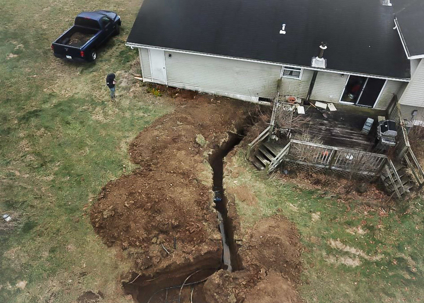
A high-efficiency geothermal unit cannot overcome a poorly designed ground heat exchanger. The equipment inside and the loop outside are one system. If the building load, heat pump and loop are not matched, performance and operating cost will suffer.
This is where geothermal experience matters most. Installing a familiar air handler does not automatically qualify a company to design the ground side.
Begin with the building load
The designer first needs a defensible heating and cooling load. DOE guidance identifies assessment of peak loads as critical and warns that oversizing can reduce efficiency and humidity control through excessive cycling.
The load calculation describes what the house needs. It does not, by itself, determine loop length.
Then model the ground heat exchanger
Loop design considers:
- Annual heating extraction and cooling rejection.
- Ground temperature and thermal conductivity.
- Soil, rock and groundwater conditions.
- Bore or trench geometry and spacing.
- Pipe size, length and antifreeze solution.
- Flow rate and circulator energy.
- Entering-water-temperature limits for the selected equipment.
- Long-term thermal balance.
DOE notes that accurate ground properties are crucial and that software tools are available for loop sizing. For larger or unusual projects, thermal-conductivity testing may be appropriate.
Why “tons” are not enough
Two four-ton homes can require different loops. One may have balanced annual heating and cooling; the other may extract far more heat over a long Ohio winter. Wet soil and dry rock do not transfer heat identically. A horizontal field and a vertical borefield also behave differently.
The design should be based on calculated loads and site conditions, not only a standard footage allowance.
Water flow and pumping matter
The loop has to move enough fluid through the heat exchanger without wasting excessive pump power. Too little flow can reduce capacity and trigger faults. Excessive flow may add electrical consumption without a matching performance benefit.
Pressure drop, header layout, pipe diameter, antifreeze concentration and flushing all affect the installed result. Air left in a closed loop can create noise, poor flow and service problems.
What happens when the loop is undersized
Entering water can move outside the intended range during peak weather. The heat pump may lose capacity or efficiency, run longer, use more backup heat or lock out on a protective control. Those symptoms can be mistaken for a failed indoor unit when the root issue is the ground side.
An oversized loop generally performs well but costs more to install. Good design aims for dependable long-term operation and reasonable project cost rather than simply adding pipe without analysis.
Frequently asked questions
Can the existing loop be reused with a new geothermal unit?
Often it can, but verify configuration, condition, fluid, flow and capacity for the new equipment. Do not assume matching nominal tonnage proves compatibility.
Does loop pipe wear out quickly?
DOE estimates ground loops can last 50 years or more when properly designed and installed. Connections, fluid and accessible mechanical components still require proper service.
Is loop design required for an open-loop system?
Yes, although the inputs differ. Well yield, temperature, water quality, discharge and pumping energy replace some closed-loop considerations.
Ask for both sides of the design
West Jefferson Plumbing & Heating evaluates the home's load and the ground heat exchanger as a coordinated system. For geothermal projects around Circleville and Central Ohio, we can explain the loop assumptions, expected water temperatures and backup-heat strategy before installation.
Suggested internal links: HVAC Services; Article 5 and Article 13 in this package Authoritative sources: DOE purchasing guidance for geothermal heat pumps; IGSHPA: Loop Design Done Right