
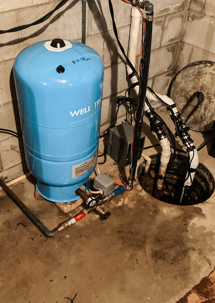
A conventional well pump should not start and stop every few seconds while a faucet runs steadily. Rapid cycling adds starts to the motor, creates pressure swings and usually means the system is not storing or controlling water as intended.
The pressure tank is a common cause, but it is not the only cause.
What the pressure tank does
A pressure tank stores a limited amount of water under air pressure. Small uses can draw from the tank without starting the well pump immediately. When pressure reaches the switch's cut-in setting, the pump starts and refills the tank until cut-out.
The National Ground Water Association explains that the tank's reserve prevents the pump from switching on for every small demand. The tank does not increase the well or pump's sustainable flow.
How a failed tank causes short cycles
In a bladder or diaphragm tank, the air cushion and water are separated. If the bladder fails or air charge is incorrect, usable drawdown can become very small. Opening a faucet quickly drops pressure to cut-in, the pump adds a small volume, pressure jumps to cut-out and the cycle repeats.
Checking precharge requires the pump to be off and water pressure drained, then comparing the measured air pressure with the manufacturer's requirement for the switch settings. Do not add air blindly to an energized, pressurized system.
Other possible causes
- A pressure switch with damaged contacts or a clogged sensing port.
- Incorrect cut-in/cut-out settings.
- A check valve or foot valve that lets pressure fall with no household use.
- A plumbing leak or running fixture.
- An undersized tank for the pump and use pattern.
- A pump-control or variable-speed drive fault.
- Well-yield problems or a pump that does not match the system.
Watch whether pressure falls when no water is being used. That helps separate a storage problem from leakage or backflow, but electrical diagnosis belongs to a qualified professional.
Why not to ignore it
Motor starts create heat and mechanical stress. Short-cycling can damage the pump, switch and controls, turning a tank or valve problem into a more expensive well-pump repair.
If the pump also draws air, sand or cloudy water, stop heavy use and call promptly. Pumping sediment can damage well equipment, and sudden water-quality changes deserve testing.
Frequently asked questions
Is 30/50 or 40/60 pressure better?
Either range can be appropriate when the pump, tank, fixtures and building elevation support it. Do not change the switch without checking tank precharge and system limits.
Will a larger pressure tank increase well yield?
No. It increases short-term drawdown and may reduce starts, but it does not make the aquifer produce more water.
Should I replace the pump and tank together?
Only when testing supports both. A failed pressure tank does not prove the submersible pump is bad.
Protect the pump by diagnosing the cycle
West Jefferson Plumbing & Heating evaluates well pumps, pressure tanks, switches and connected water treatment for rural homes around Circleville and across Pickaway, Ross, Fairfield and Fayette Counties.
Suggested internal links: Plumbing Services; Article 22, Article 23 and Article 25 in this package Authoritative sources: National Ground Water Association water-pressure guidance; NGWA annual well checkup; Penn State water-well maintenance
Homeowner question that inspired this article: A homeowner reports a well pump turning on about every ten seconds