
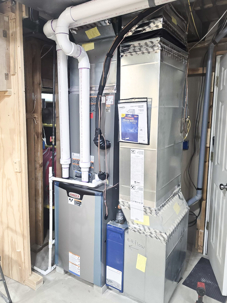
When homeowners compare HVAC quotes, efficiency ratings tend to get most of the attention. In the field, the difference people often notice every day is not the number on the label. It is how the equipment delivers capacity.
The simplest explanation is a light switch, a two-step switch and a dimmer.
Single-stage: full output or off
A single-stage air conditioner, heat pump or furnace starts at full capacity and runs until the thermostat is satisfied. Then it shuts off. This equipment is straightforward and can perform well when it is properly sized, installed and connected to an effective duct system.
The tradeoff appears during mild weather. Central Ohio equipment is selected for demanding summer and winter conditions, but many hours occur well below those peak loads. A single-stage air conditioner may satisfy the thermostat quickly on a humid 75°F day. The room gets cool, but the coil may not stay cold long enough to remove as much moisture as the homeowner expects.
Two-stage: a useful middle step
A two-stage system can begin at reduced capacity and move to full output when the load or runtime requires it. That lower first stage creates longer cycles during moderate weather. The result can be steadier temperature, quieter operation and better summer moisture removal than comparable single-stage equipment.
Two-stage is not infinitely variable. It still has defined operating levels, and the controls must be set up correctly. But it can be a practical compromise between first cost and comfort.
Variable capacity: HVAC on a dimmer switch
Variable-capacity equipment can adjust compressor and fan output across a broad operating range. Instead of waiting for the house to drift far enough from setpoint and then attacking the load at full speed, it can run for much of the hour at low capacity.
DOE explains that staged and variable compressors can operate closer to the capacity the building needs at a given moment, reducing on-and-off operation. That is why “it runs all the time” is not necessarily a complaint with this equipment. A long, quiet cycle at low power can be exactly what the system was designed to do.
The comfort benefits homeowners notice
More even temperature
Short full-output cycles can create noticeable peaks and valleys. Modulating equipment can maintain a tighter range around the thermostat setting.
Better dehumidification
Moisture removal requires air to pass over a cold coil. Longer low-capacity cooling cycles provide more opportunity for condensation to form and drain. This matters in Ohio's many warm, rainy days when the sensible cooling load is modest but humidity remains high.
Quieter operation
Compressors, outdoor fans and indoor blowers operating below full speed can be much less noticeable.
Potential energy savings
Variable capacity can reduce cycling losses and operate efficiently at part load. Actual savings still depend on equipment selection, ductwork, controls, utility rates, construction and how the home is used. Comfort is often the most reliable reason to choose it; savings should be modeled, not promised.
What variable equipment cannot fix
A sophisticated unit cannot perform miracles through a poor distribution system. Undersized returns, leaky ducts, crushed flex, missing insulation or badly balanced branches can still leave rooms uncomfortable. A variable blower may help, but the duct system has to move the required air.
The equipment also must be selected from a real load calculation and commissioned correctly. Buying the most advanced cabinet does not replace design work.
Frequently asked questions
Is variable speed the same as variable capacity?
Not always. “Variable-speed” may describe the indoor blower while the compressor remains single- or two-stage. Ask exactly which components modulate and what controls them.
Does a longer runtime cost more?
Runtime alone does not reveal consumption. A system running at low output can use less power than repeated full-capacity cycles. The operating percentage and measured energy matter.
Is two-stage worth considering?
For many homes, yes. It can improve runtime and humidity control without the full cost or control complexity of a variable-capacity system.
Choose the system, not just the rating
West Jefferson Plumbing & Heating helps Central Ohio homeowners compare equipment in the context of the house: load, ductwork, humidity, sound, comfort goals and budget. From Circleville through Pickaway, Ross, Fairfield and Fayette Counties, our goal is to explain what each option will change—and what it will not—before you invest.
Suggested internal links: HVAC Services; Indoor Air Quality; Article 5 in this package Authoritative source: DOE Heat Pump Systems—advanced technologies