
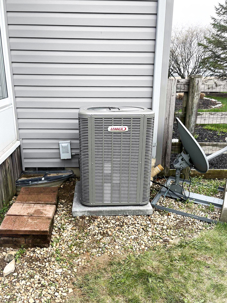
An old serial number is not a diagnosis. We regularly see homeowners told that a furnace, air conditioner or heat pump must be replaced because it crossed a particular birthday. Age matters, but it is only one part of a responsible decision.
If the system is safe, repairable and still meets the homeowner's needs, repair may be reasonable. If it has a major failure, repeated breakdowns or a design problem that cannot be corrected economically, replacement may be the better long-term choice.
Start with what actually failed
A weak capacitor, damaged wire or clogged drain is not the same decision as a failed compressor, cracked heat exchanger or leaking coil. Ask for the failed component, the measurements that support the diagnosis and the cost of restoring reliable operation.
For a refrigerant problem, “it is low” is incomplete. Refrigerant does not get used up. The system should be evaluated for a leak and the likely repairability explained before repeated recharging becomes the plan.
Age changes the economics—not the facts
Older equipment may have parts that are difficult or costly to obtain. It may use a refrigerant that changes the repair calculation, and it may be outside the manufacturer's parts warranty. A large repair on an older system deserves comparison with replacement.
That still does not mean every repair is wasted money. A modest repair that safely provides additional service can be a sound choice, especially if the homeowner needs time to plan and compare replacement options.
Factors that favor repair
- The problem is isolated and the rest of the equipment is in good condition.
- Parts are available and the repair carries a useful warranty.
- The system has not required repeated major repairs.
- Comfort, humidity and operating costs are acceptable.
- The repair cost is reasonable relative to replacement and the homeowner's timeline.
Factors that favor replacement
- A major component has failed and the remaining equipment is also near the end of its useful service.
- The system has recurring leaks or multiple costly failures.
- There is a verified safety problem or severe installation defect.
- The equipment cannot keep up because it was incorrectly sized or the home changed.
- The homeowner wants a meaningful improvement in zoning, humidity, sound or backup-power compatibility.
Efficiency can support replacement, but projected savings should be realistic. A new rating does not guarantee a particular bill because weather, duct leakage, thermostat settings, fuel price and household use all matter.
Do not decide under pressure
When the proposal is large, get another qualified opinion. Ask for repair and replacement options in writing, and compare scope—not just the bottom-line number. The cheapest bid may omit load calculations, permits, duct corrections, controls or warranty coverage. The most expensive proposal is not automatically the most complete.
Be cautious when a decision must supposedly be signed at the kitchen table that evening. A true safety issue should be documented and addressed, but a sales deadline is not a mechanical emergency.
Frequently asked questions
Is a 15-year-old air conditioner automatically done?
No. Condition, failure type, repair history and parts availability matter. Age is a reason to plan, not proof of a specific failure.
Should I replace the furnace and AC together?
Sometimes matched components, controls, refrigerant compatibility or labor make that sensible. In other cases, only one side needs work. Ask what technical requirement supports replacing both.
How many estimates should I get?
For a major replacement, at least one independent second opinion is prudent. Compare design, equipment match, installation scope, warranty and service support.
An explanation before a recommendation
West Jefferson Plumbing & Heating evaluates what failed and explains repair and replacement choices without treating age as the only answer. We serve Central Ohio, Circleville and homeowners across Pickaway, Ross, Fairfield and Fayette Counties.
Suggested internal links: HVAC Services; HVAC Service Agreements; Article 5 in this package Authoritative source: ENERGY STAR HVAC maintenance checklist
Homeowner question that inspired this article: A homeowner received a $4,000 diagnosis, then a second company repaired failed terminals for $223